From the necessary revision of the concept of nature, I am interested in the gestures that emerge as we articulate interspecies alliances and imagine possible futures.
Since 2016, my practice has evolved through guiding questions that respond to changing ecological conditions, cultivating vocabularies and forms of attention that unsettle colonial taxonomies shaping our relationships with the environments we inhabit.
In nature waste does not exist, let words fragment, decay, and nourish what has not yet germinated. From this, my investigation understood language as organic matter thus exploring composting as a methodology for artistic creation, grounded in the understanding that for something to decompose, it must first be porous.
Since 2016, my practice has evolved through guiding questions that respond to changing ecological conditions, cultivating vocabularies and forms of attention that unsettle colonial taxonomies shaping our relationships with the environments we inhabit.
In nature waste does not exist, let words fragment, decay, and nourish what has not yet germinated. From this, my investigation understood language as organic matter thus exploring composting as a methodology for artistic creation, grounded in the understanding that for something to decompose, it must first be porous.
In 2023, I began exploring porosity as a methodology to remain permeable to relational entanglements, cultivating forms of knowledge that are both situated and sensitive, a way to challenge dominant modes of knowledge production.
This, in 2026, is what has led me to accumulate gestures for practicing porosity, becoming a living investigation that allows me to inhabit decomposition and sustain sensitivity within contexts of accelerated change and deep erosion.
The following are a selection of projects that have embodied this process:
This, in 2026, is what has led me to accumulate gestures for practicing porosity, becoming a living investigation that allows me to inhabit decomposition and sustain sensitivity within contexts of accelerated change and deep erosion.
The following are a selection of projects that have embodied this process:


Despliegues
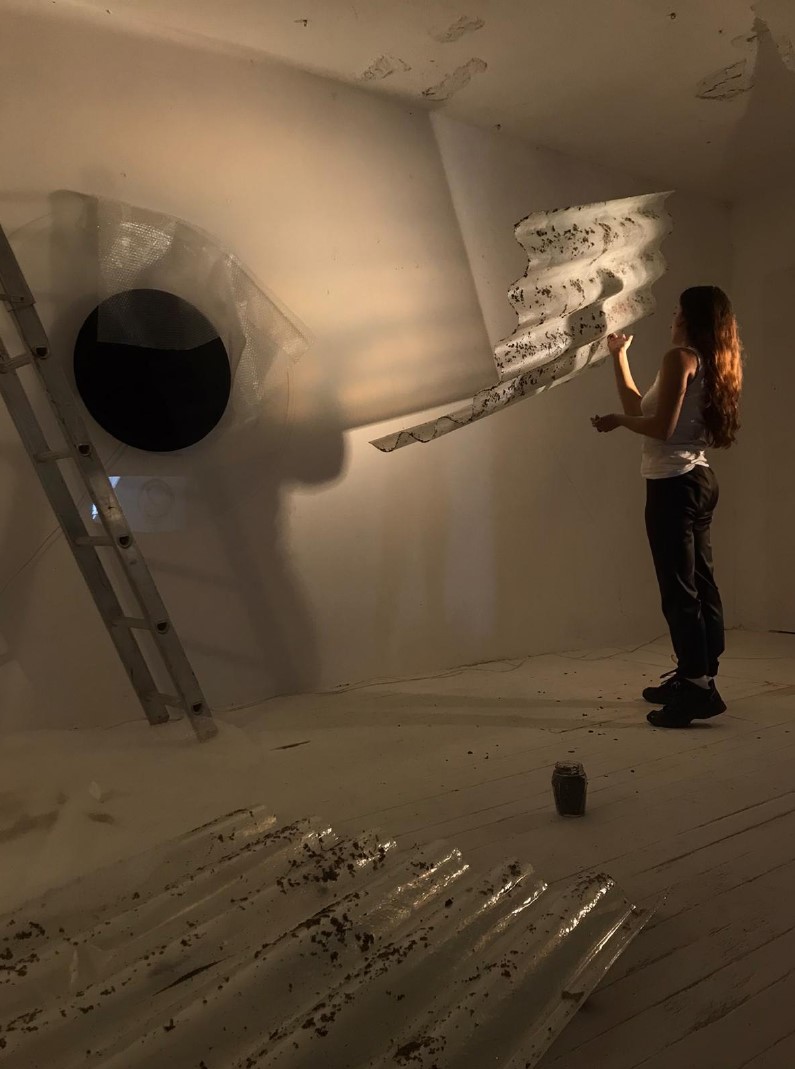
Over the upcomming months I will be experimenting the workspace as artwork in itself, a place to explore documenting and opening my procedural practice, capturing the subtle nuances of my research. Acumular gestos del residuo, el fallo y la fragilidad.
2026: Residency Il.lacions Gallery, Barcelona, ES
Over the upcomming months I will be experimenting the workspace as artwork in itself, a place to explore documenting and opening my procedural practice, capturing the subtle nuances of my research. Acumular gestos del residuo, el fallo y la fragilidad.
2026: Residency Il.lacions Gallery, Barcelona, ES

Not All Flowers Follow The Sun (2026)
An installation and investigation in process that presents a series of motorized, decomposing sunflower-heads out of step with the sun.
By reflecting on land through waste, each investigation this year has brought me to finding repair is carried by vulnerable bodies. This piece was initiated with the intention of learning from the ways in which flowers decompose through exploring programming languages and motors, bringing me to question what “not all flowers follow the sun” means to me, words I woke up with a month ago.
2026: Production Grant, Casa RARO, Barcelona, ES
2026: Convent de Sant Augustí, Barcelona, ES
If not all flowers follow the sun, then which do. Sunflowers was my intuitive response. Since, I have been sharing with sunflowers learning about their porous threshold, the ways in which they are entered, altered and shared.
An installation and investigation in process that presents a series of motorized, decomposing sunflower-heads out of step with the sun.
By reflecting on land through waste, each investigation this year has brought me to finding repair is carried by vulnerable bodies. This piece was initiated with the intention of learning from the ways in which flowers decompose through exploring programming languages and motors, bringing me to question what “not all flowers follow the sun” means to me, words I woke up with a month ago.
2026: Production Grant, Casa RARO, Barcelona, ES
2026: Convent de Sant Augustí, Barcelona, ES
If not all flowers follow the sun, then which do. Sunflowers was my intuitive response. Since, I have been sharing with sunflowers learning about their porous threshold, the ways in which they are entered, altered and shared.
El girasol que gira en busca del sol, gira, busca, encuentra y vuelve. As they mature, they come to face east permanently, warming earlier and drawing more pollinators. Sunflowers are plural. Its reproductive body is collective. Each flower is hermaphroditic, carrying both pollen and stigma. Each can move through a pollen-shedding phase before its receptive phase. Sexual identity, a matter of timing. Es una flor que esconde entre sus pétalos flores enteras que para polinizarse de a miles. Una flor peluda con escamas, de mil cabezas. The sunflower has had its multiplicity tamed into a single heavy head. A plant born to scatter is now a domesticated and obedient body. A body introduced into phytoremediation processes, planted into landscapes transformed by extraction, industry, warfare and waste, for its capacity to absorb contaminants from soil and water. The plant temporarily embodies materials that have become displaced by human activity. The roots pull heavy metals, radioactive elements and organic pollutants from the ground, storing them in the tissues, mostly in roots and leaves, sometimes as far as the seeds. As contaminants accumulate, they alter growth, damage tissue and weaken seeds. Repair carried by vulnerable bodies


The Softest Hard,
(A Practice of Porosity, Hangar)
Methodology: Allow proximity to rearrange matter
Methodology: Allow proximity to rearrange matter
A Practice of Porosity is a living research project that holds space for what is left behind.
There is a gentleness in decay, an intelligence that inhabits things as they open towards their own undoing.
2026: Residency Hangar Barcelona, ES
2026: Art Nou, Tandem x Casa RARO, Barcelona, ES
The Softest Hard presents a series of objects that accumulate gestures of failure and fragility during my residency at Hangar, Barcelona. It questions the political community that invests more energy in reinforcing borders than in expanding rights.
Materially, the pieces are constructed from blown glass and the reconstruction of found objects, with multispecies collaborations and low-tech languages. Through alliances with people, materials, and tools in contexts of proximity, I have allowed remnants and relationships to ferment and reorganize into new forms of intimacy.
As part of this research, I commuted the same route every day for three months, observing the places where waste accumulates and documenting both the materials that circulate and those that remain. By placing my attention on materials that, despite being discarded or deemed undesirable, I noticed their permanence within the city.
2026: Residency Hangar Barcelona, ES
2026: Art Nou, Tandem x Casa RARO, Barcelona, ES
The Softest Hard presents a series of objects that accumulate gestures of failure and fragility during my residency at Hangar, Barcelona. It questions the political community that invests more energy in reinforcing borders than in expanding rights.
Materially, the pieces are constructed from blown glass and the reconstruction of found objects, with multispecies collaborations and low-tech languages. Through alliances with people, materials, and tools in contexts of proximity, I have allowed remnants and relationships to ferment and reorganize into new forms of intimacy.
As part of this research, I commuted the same route every day for three months, observing the places where waste accumulates and documenting both the materials that circulate and those that remain. By placing my attention on materials that, despite being discarded or deemed undesirable, I noticed their permanence within the city.
What began as a poetic gesture within my practice gradually revealed broader logics of extraction, excess, and disposal, as well as recycling systems sustained by marginalized and invisible bodies and forms of labor. At €0.20 per kilogram of iron and €1 per kilogram of aluminum, the prices expose circuits of exploitation and displaced ecological violence.
During this period, I shared a staircase with a space occupied by recyclers, who dismantle found objects daily under precarious conditions. The proximity between their gestures and my own practice generated a productive tension around the material conditions and privileges from which my work operates. Over time, this tension evolved into forms of exchange and reciprocity through the circulation of tools, materials, and care. Some of the recyclers began setting aside fragments for me, while I gathered leftover materials from my walks and from other Hangar residents to contribute to their recycling processes. These relationships became an active part of my methodology of porosity, cultivating more situated and attentive ways of making. The sculptures that emerged embody tangled, often invisible anatomies, assembled from the materials accumulated through these exchanges.
This research unfolds within a broader political context in which the European Parliament has definitively approved the “Return Regulation,” a migration framework that undermines fundamental human rights. The Softest Hard turns attention toward those who sustain the metabolism of a system that simultaneously excludes them, opening a dialogue about the future of bodies and forms of labor that have already been rendered invisible, while questioning political communities that, rather than expanding rights, reinforce borders.
During this period, I shared a staircase with a space occupied by recyclers, who dismantle found objects daily under precarious conditions. The proximity between their gestures and my own practice generated a productive tension around the material conditions and privileges from which my work operates. Over time, this tension evolved into forms of exchange and reciprocity through the circulation of tools, materials, and care. Some of the recyclers began setting aside fragments for me, while I gathered leftover materials from my walks and from other Hangar residents to contribute to their recycling processes. These relationships became an active part of my methodology of porosity, cultivating more situated and attentive ways of making. The sculptures that emerged embody tangled, often invisible anatomies, assembled from the materials accumulated through these exchanges.
This research unfolds within a broader political context in which the European Parliament has definitively approved the “Return Regulation,” a migration framework that undermines fundamental human rights. The Softest Hard turns attention toward those who sustain the metabolism of a system that simultaneously excludes them, opening a dialogue about the future of bodies and forms of labor that have already been rendered invisible, while questioning political communities that, rather than expanding rights, reinforce borders.

Methodology:
Follow the same route every day, observe the places where waste accumulates, observe what remains, what circulates.
( A Practice of Porosity, Hangar)
( A Practice of Porosity, Hangar)
A Practice of Porosity is a living research project that holds space for what is left behind.
There is a gentleness in decay, an intelligence that inhabits things as they open towards their own undoing.
2026: Residency Hangar Barcelona, ES
2026: Maker Sherpa, Convent de Sant Augustí, Barcelona, ES
2026: Residency Hangar Barcelona, ES
2026: Maker Sherpa, Convent de Sant Augustí, Barcelona, ES
This series of sculptural objects emerges from a daily practice of walking, collecting, and attending to what persists. During my residency at Hangar, I followed the same route each day, gathering discarded materials encountered along the commute. An exercise in seeing what is left behind, too broken, too useless or too little economic value that become permanent. Through repetition, the act of collecting became a method for observing patterns of circulation, abandonment, and permanence within the urban landscape.