From the necessary revision of the concept of nature, I am interested in the gestures that emerge as we articulate interspecies alliances and imagine possible futures.
Since 2016, my practice has evolved through guiding questions that respond to changing ecological conditions, cultivating vocabularies and forms of attention that unsettle colonial taxonomies shaping our relationships with the environments we inhabit.
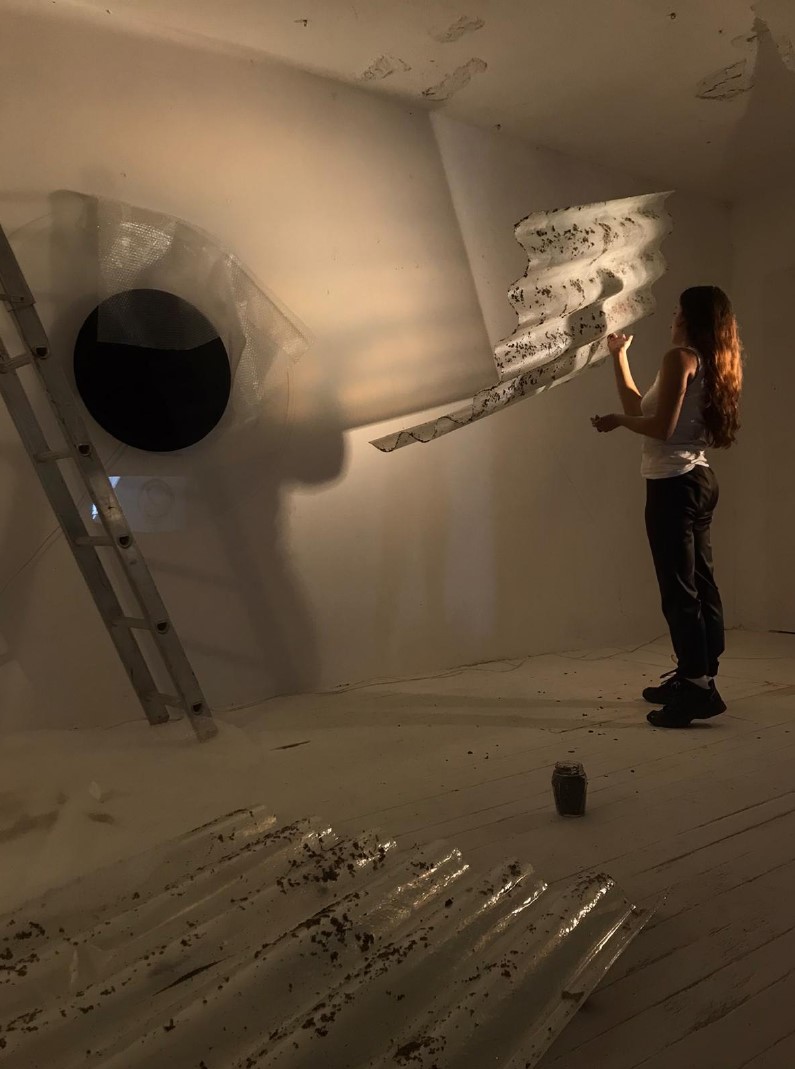
In nature waste does not exist, let words fragment, decay, and nourish what has not yet germinated. From this, my investigation understood language as organic matter thus exploring composting as a methodology for artistic creation, grounded in the understanding that for something to decompose, it must first be porous.
Since 2016, my practice has evolved through guiding questions that respond to changing ecological conditions, cultivating vocabularies and forms of attention that unsettle colonial taxonomies shaping our relationships with the environments we inhabit.
In nature waste does not exist, let words fragment, decay, and nourish what has not yet germinated. From this, my investigation understood language as organic matter thus exploring composting as a methodology for artistic creation, grounded in the understanding that for something to decompose, it must first be porous.
In 2023, I began exploring porosity as a methodology to remain permeable to relational entanglements, cultivating forms of knowledge that are both situated and sensitive, a way to challenge dominant modes of knowledge production.
This, in 2026, is what has led me to accumulate gestures for practicing porosity, becoming a living investigation that allows me to inhabit decomposition and sustain sensitivity within contexts of accelerated change and deep erosion.
The following are a selection of projects that have embodied this process:
This, in 2026, is what has led me to accumulate gestures for practicing porosity, becoming a living investigation that allows me to inhabit decomposition and sustain sensitivity within contexts of accelerated change and deep erosion.
The following are a selection of projects that have embodied this process: